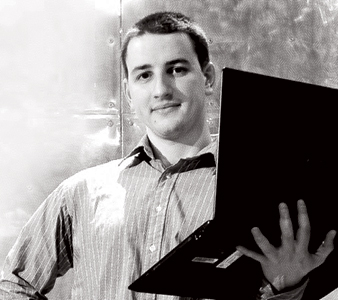
In the three years after he graduated, Anton consulted for Google and led a startup company that arranges unique tours and experiences.
 While technology innovators are often stereotyped as not needing college鈥攂oth Microsoft founder Bill Gates and Facebook founder Mark Zuckerberg dropped out before graduating鈥�Stephen Bloch, Ph.D., an associate professor of mathematics and computer science at 91国产, argues that most benefit from completing an undergraduate computer science degree.
“For people who are very good on the tech side but also really driven by the entrepreneurship, dropping out might be the best route for them to go,” Dr. Bloch says. “On the other hand, it鈥檚 easier to get original ideas if you have a lot of exposure to the ideas that others have already come up with. Then you don鈥檛 keep inventing the same ideas that have already been tried and failed. For the people who are going to be primarily on the tech side, and not founding their own companies, they鈥檙e going to benefit from as much technical background as they can get. There are bad ways to solve problems and better ways to solve problems. You can short-circuit a lot of bad ideas by learning from other people鈥檚 experiences.”
Anton Soradoi 鈥�10, agrees.
“A big impact on me was Dr. Bloch鈥檚 course on the UNIX operating system,” the Estonian native says. “We really went under the skin of how things work in a computer. I remember thinking I could program anything after that.” Mr. Soradoi says the solid grounding in the fundamentals has set him up for a career that can go in many different directions. In the three short years since he graduated, he鈥檚 consulted for and now leads technology development at , a startup company that arranges unique tours and experiences for anyone who鈥檚 interested, for example, tagging sharks in Florida or designing perfume in New York. He鈥檚 also working on a game for the Android phone that he started developing while at 91国产 and hopes to finish one day.
At 1000 Passions, Mr. Soradoi handles anything to do with technology at the company, from developing the website to improving performance and coming up with new ways for users to interact with the site, to managing the servers and providing the technology perspective at business strategy meetings. Mr. Soradoi says he enjoys working in technology because, 鈥淚t never gets boring.”
“It鈥檚 not the same job over and over again. And I love to create something completely new that didn鈥檛 exist before.”Dr. Bloch says the majority of students sign up for computer science because they want to become video game programmers. “Most won鈥檛,” he says, “but conveniently enough, a lot of the stuff you need to program a video game is also useful in programming a word processor or a browser or a database program.” Programming is simply teaching a computer how to make decisions, Dr. Bloch explains. “A computer that can鈥檛 make decisions is just a calculator,” he explains. “But if we give them a program, they can make decisions without us supervising. They can run on their own, decide when they鈥檙e done and decide which of three different things to do without being told every step of the way.”
The catch is that it鈥檚 not always obvious what you need to tell the computer to get it to do what you want to do.
“If you鈥檙e someone who鈥檚 going to give up easily when you can鈥檛 get something to work immediately, computer programming is not for you,” says current computer science major Hannah Groves 鈥�14. “However, if you鈥檙e the type of person who doesn鈥檛 sleep until they fix whatever鈥檚 wrong, that鈥檚 the kind of mindset you need with computers. Because sometimes it鈥檚 something as silly as you鈥檙e missing a semicolon at the end of the line. And nothing鈥檚 worse than when you鈥檙e hitting the same error over and over and you realize you forgot to type the semicolon.”
At the same time, that鈥檚 part of what makes technology interesting, says Ms. Groves, who hopes to become a software developer at an Internet company after she graduates. “It鈥檚 rewarding when there鈥檚 something really complicated and you figure it out on your own. You just have to be willing to try the same problem from 12 different angles with 16 different methods.”
听
For further information, please contact:
Todd Wilson
Strategic Communications Director听
p 鈥� 516.237.8634
e 鈥� twilson@adelphi.edu